
Having delivered school workshops since 2017, a number have been developed and refined to support the National Curriculum but also as unique sessions to inspire young minds in science using the context of space and space travel. Each workshop is flexible with a range of material supporting different ages and involving appropriate practical activities.
Launching Rockets
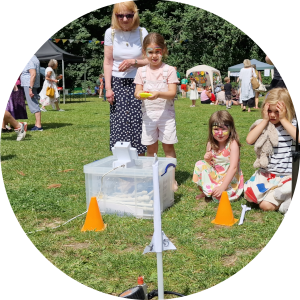
An exploration of Every Action has an Equal and Opposite Reaction or Isaac Newton’s third law. Using practical demonstrations and craft activities, students explore how gases rushing out of a container in one direction, push the container the other way depending on the rate and amount of the gas escaping and how heavy the container is and its shape. Demostrations can include balloon rockets, Alka Seltzer rockets, stomp and compressed air paper rockets, and water powered bottle rockets. The objective is to appreciate the challenges of using rockets for satellites and crewed spaceflight. Students create their own paper rockets and can take them home.
Suitable for Reception to KS3 students (content varies based on age). Duration is 1 hour.
Space Rocks!!
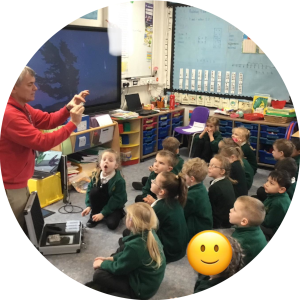
A journey from just before the Sun formed 4.5 billion years ago to the Solar System we see around us today. Using practical demonstrations to help understand how microscopic dust came to be the first dust bunnies, formed the first small rocks and finally came to form mini planet-like things. An age of planet-forming impacts ensues. The Earth may have been hit by a Mars sized object resulting in the formatin of the Moon. The remaining rocks whizzed around the Solar System, sometimes hitting other rocks and planets. The resulting craters can be seen on the Moon and the Earth. If we’re lucky some of the original rocks survive to let us hold 4 billion year old meteorites in the classroom.
Suitable for Reception to KS2 students (content varies based on age). Duration is 1 hour.
Exploring the Sun
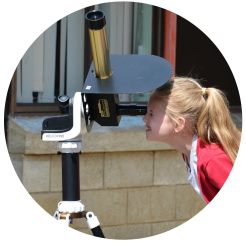
The Sun is the source of energy that created nearly everything around us. Everyone is made of star stuff and some of that stuff was made in the heart of huge ancient stars, long gone and older than our Sun. Find out who discovered what stars are made of and how she did it. Practicals can demonstrate using the Sun as a clock, measuring the diameter of the Earth, and finding almost invisible gaps in rainbows. If weather permits, the workshop can include live observations of the surface of the Sun with specialist solar telescopes.
A variation of this workshop entitled “Cecilia Payne – the English Woman who discovered what stars are made of” is available which concentrates more on the work of the Harvard Computers and Cecilia Payne.
Suitable for KS2 students and above. Duration is 1 hour.
Discovering Telescopes
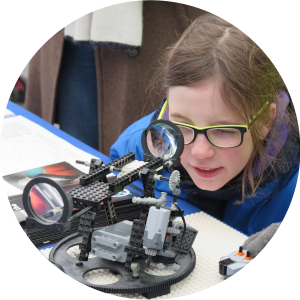
The Dutch Trunke was the name given to the new invention of the telescope in Netherlands at the beginning of the 17th century. Discovering Telescopes takes everyone from 12th century eye glasses to the Extremely Large Telescope in Chile. The demonstrations and practicals include making simple refracting telescopes from scratch, exploring lens and magnification, and seeing how refracting and reflecting telescopes work. If weather permits, the workshop can include live observations of the Moon with standard telescopes or the surface of the Sun with specialist solar telescopes.