
On the evening of Wednesday 12th August 2026, the Moon will pass directly between the Earth and the Sun causing a shadow to be cast on the Earth. Due to the relative motions of the Moon and the Earth, this shadow will start in northern Russia, pass over Greenland, western Iceland and across northern Spain. For a location on the path of the shadow, the Sun will be completely covered by the Moon for between 1 minute and 2 minutes 18 seconds, a total solar eclipse. The UK is not on the path but will witness a partial solar eclipse between 6:17pm and 8:07pm. It is the biggest eclipse visible in the UK until 23rd September 2090.
The following resources have been collated to help explain the eclipse to students:
- Video and images of the eclipse and its path around the world
- Video explaining why eclipses occur for differing age ranges of students (Key Stages 1/2 with Paxi and the Moon, Key Stage 3+ What is an Eclipse?)
- Useful graphics for explaining the different types of eclipse
- ESA’s full 73 page educational kit on eclipses with explanations, practical activities and observation tips.
Online resources
- Time and date information of eclipses, Timeanddate.com
- UK-based info on the upcoming eclipse, UKEclipse.com
- Solar eclipse maps from 2025 to 2100, DataViz Dojo – recommended
Path and simulations of the 12th August 2026 partial solar eclipse

Total solar eclipse 12 August 2026 – Global map
- CREDIT
European Space Agency (ESA) - ACKNOWLEDGEMENTS
ATG Europe - LICENCE
CC BY-SA 3.0 IGO or ESA Standard Licence
(content can be used under either licence)
Eclipse Videos from ESA, the European Space Agency
Paxi and our Moon: phases and eclipses is a great introduction for 6 to 12 year olds to the Moon and the shadows associated with it. The first part is all about the phases of the Moon and from 3:03 in the video, Paxi introduces eclipses
What is an Eclipse? This short video explains the difference between lunar and solar eclipses, regularly occurring events that can be observed from Earth. It is ideal for key stage 3 and above. The solar eclipse explanation begins at 0:49 in the video.
Useful graphics

Solar eclipse
- CREDIT
European Space Agency (ESA) - ACKNOWLEDGEMENTS
ATG Europe - LICENCE
CC BY-SA 3.0 IGO or ESA Standard Licence
(content can be used under either licence)

Partial solar eclipse
- CREDIT
European Space Agency (ESA) - ACKNOWLEDGEMENTS
ATG Europe - LICENCE
CC BY-SA 3.0 IGO or ESA Standard Licence
(content can be used under either licence)

Total solar eclipse
- CREDIT
European Space Agency (ESA) - ACKNOWLEDGEMENTS
ATG Europe - LICENCE
CC BY-SA 3.0 IGO or ESA Standard Licence
(content can be used under either licence)

Types of solar eclipse
- CREDIT
European Space Agency (ESA) - ACKNOWLEDGEMENTS
ATG Europe - LICENCE
CC BY-SA 3.0 IGO or ESA Standard Licence
(content can be used under either licence)

Solar and lunar eclipses
- CREDIT
European Space Agency (ESA) - ACKNOWLEDGEMENTS
ATG Europe - LICENCE
CC BY-SA 3.0 IGO or ESA Standard Licence
(content can be used under either licence)
CESAR Eclipses Education Kit
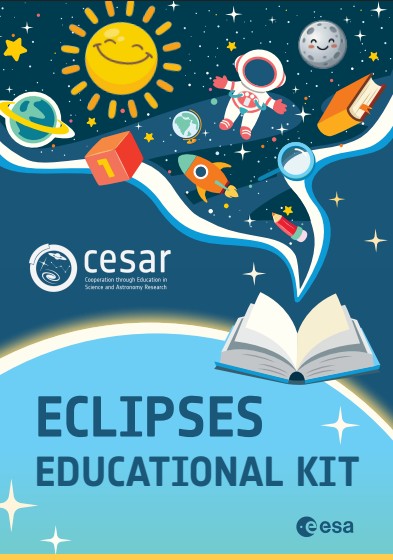
This educational kit has been designed to accompany this exceptional event with practical, clear, and engaging activities to help understand how eclipses occur, the differences between total, annular, and partial eclipses, and how to prepare for safe observation.
Explore the kit together with its characters directly or download it below to use it offline. A resource designed to support teachers, families, and students with accessible, inclusive, and adaptable activities for different learning contexts. Enjoy!
Click the image to download the 73 page pdf.
Recommended activities for 6 to 12 years appear from pages 13 to 44. It includes creating your own eclipses, safely using solar glasses and building your own pinhole camera.
Recommended activities for 13 to 18 years appear from pages 45 to 69 . It includes what an eclipse is and how to build your own spectroscope.
Astro Thoughts have been distributing solar glasses to local schools in Bath, Somerset and Wiltshire ahead of the event. The glasses are kindly provided by Bath Astronomers via Go Stargazing and First Light Optics.